Commentaries on Local Justice by Bill Martin

Tag: broome county jail (Page 2 of 2)

Broome County Jail’s Secret $ millions:  profiting from COVID and incarcerated families

Broome County devotes a large share of its budget to maintaining its reputation as having the highest incarceration rate among New York State’s 62 counties. The Sheriff alone gets over $30 million each year for his jail, even as the number of persons incarcerated there has steadily fallen in recent years. Meanwhile the official county budget for the jail increases year after year.

What remains unseen and unaccountable however is additional, rapidly growing funding on the scale of millions of dollars as COVID conditions have been exploited.  And the most punishing and hidden funding comes directly from the poorest residents of the county—the families and friends of those incarcerated in the jail.

$7 million in COVID funding

Take for example last month’s County’s allocation of $7 million in Federal COVID recovery funds to reportedly “public safety revenue replacement.”  Did these millions go to public health, housing, infrastructure, or youth employment recovery?  Far from it: a freedom-of-information (FOIL) request reveals they were sent directly to the Sheriff’s budget for correctional officers—even as the jail, built and expanded to hold 600 persons, now holds less 300 local residents and only 42 persons convicted and sentenced for a crime. How and why $7 million?  We don’t know.

Unseen Cell Profits by the $ millions

Even more hidden and unaccountable are the profits generated in recent years by selling cells to the Federal government and other local Sheriffs.  Last month the jail housed 25 persons for the federal government, for example,  and received $100 to $300 per day for each. That’s $ millions in cell profits over time, not counting payments for holding persons for other counties.

Preying on incarcerated families: another $1 million+ ?

Most punishing are the funds charged to the incarcerated and their family and friends. COVID has had a dramatic impact here as well.  Unable to visit in person and desperate to talk to their loved ones, families have been forced to pay for both telephone and video calls. For the Sheriff it’s a lucrative enterprise, as county contracts dictate high commissions to be paid directly to the Sheriff to be used as he decides. Here too it took a FOIL request to uncover the contracts and revenues, and how they were spent behind closed doors.

The pages attached here contain the response from the Broome County Sheriff to the FOIL request that asked for telephone and video revenues for 2019, 2020, and 2021. County contracts dictate that the Sheriff rake offs 44% of all costs from telephone calls to/from the jail, and 20% for all video tablet use (both calls and content).   The figures supplied by FOIL show the commission payments to the Sheriff (but exclude the GTL shares, which means that the total charges for families are much larger (2.27 x larger for telephone calls and 5 times larger for video)).

As reported by the Sheriff, telephone calls alone generated these commissions, and by extrapolation the calculated total cost that includes the GTL share (based on the contract commission rate). 

 Sheriff’s
Commission $
Estimated Commission
plus GTL charge $
2019303,722690,360
2020309,779704,129
2021528,9001,202,190

Are these excessive costs?  You judge. The  rate for a one minute phone call for persons in

State prisons:  3.9 cent
Broome County Jail: 25 cents

To the telephone figures one must add profits from video calls.

It need not be this way: one could have open competitive contracts, eliminate commission fees, or even drop fees for telephone calls as some jails have done (comparative jail rates are available from the striking reports generated by www.prisonpolicy.org ). Meanwhile all state prisons and surrounding jails have restored in-person visits, which Sheriff Harder refuses to do—ensuring a continuing flow of profits under his control.

And where did the Sheriff spend these funds? As reported elsewhere, telephone and video profits were spent on everything from retirement party banners to a second, $273,000 armored personnel carrier.

Broome County Bearcat, funded by the incarcerated

Super profits from Commissary

And even that is not enough. Cut off from families, and denied access to outside vendors, those languishing in the county jail under COVID  became even more dependent upon food, hygiene products, and other basic goods purchased from the jail commissary run by a private corporation—and from which the Sheriff skims off yet more profits.  

State regulations dictate that profits be modest and be spent on the welfare and rehabilitation of the incarcerated.  As the attached foil demonstrates, under COVID profits accelerated by 50% to over $300,000 a year–and were spent on purchases that had nothing to do with rehabilitation or welfare, from carpeting and vacuum cleaners, to religious plays, to gardening supplies and lawn tractors.  When Justice and Unity for the Southern Tier in 2019 asked the County Executive and State Commission of Correction to investigate these misappropriations, they declined to respond–as did the NYS Attorney General and Comptroller to whom copies were sent.

Demanding Oversight

The lesson here is straightforward:  excessive $ millions are secretly spent every year on the jail, much directly taken from the pockets of the poorest Broome county residents. There is no accountability, no county or state oversight.  The solution? Independent community oversight.

Broome County’s Militarized Bearcats: what do they do and who funded them?

What is a Bearcat? Mention the word in Binghamton and most will think of the mascot of SUNY-Binghamton’s sports teams.

For police chiefs and the sheriff it’s another animal altogether:  an armored personnel carrier, most often used to carry SWAT teams into action or counter civil protest.  And where there was one, there are now two.

Produced by the Lenco Corp for military use worldwide, BearCats are personnel carriers with armored steel bodies, ballistic glass capable of multiple high-powered weapon hits, and blast-resistant floors. The first local BearCat was obtained in 2019 by the Binghamton Police Department and introduced with celebration by the Republican Mayor, the Democratic County Executive, and our Republican State Senator:

Mayor David, State Senator Akshar, County Executive Garnar and BPD BearCat team

The City was playing catch up here:  over five years earlier the Broome County Sheriff got himself an armored personnel carrier, a surplus apartheid war machine, a South African Casspir:

Not to be outdone by the City, Sheriff Harder has apparently retired the Casspir and purchased his own BearCat for his own SWAT team–at the cost of $273,000.  

Broome County BearCat

It isn’t clear at all what such a war vehicle will do. Last year the Broome SWAT team was primarily used for drug raids on unarmed persons—and the constant policing of protests and parades.  Indeed, the most notable use of the BearCat according to the Sheriff’s own annual report was its dispatch to a Black Lives Matter protest in Troy NY (2020 Annual Report, p. 36).

And where did the $273,000 come from?  You won’t find it in Broome County Budget sheets. It took a freedom-of information request to find the source: the pockets of the poorest residents of the county, those incarcerated in the Sheriff’s jail. 

Out of sight and unmonitored, the Sheriff reaps huge profits from running a monopoly telephone and video exchange for those incarcerated in the jail.  A 15 minute call that costs 65 cents from a state prison costs at least $3.75 from the Broome jail and can run up to $9.95 with setup and billing charges. The Sheriff skims off 44% of revenues from all telphone calls and 20% of all video tablet use.  Profits in 2020 came to $373,000 and paid for everything from the BearCat to retirement party banners to outfitting conference rooms. Under COVID, profits rose to $655,000 in 2021.

These revenues rest on the exploitation of families desperate to remain in contact with loved ones locked behind closed doors, out of sight.  As state and local authorities relax COVID restrictions it is harder and harder to justify keeping in-person visitation closed. State prisons have long ago reinstated in-person visitation with social distancing.  County jails across the state, including those in nearby counties, have done the same.  In an effort to force the same, Justice and Unity for the Southern Tier and families of the incarcerated have filed a lawsuit with the assistance of Legal Services of Central NY demanding a return to family visits.

Sheriff Harder has refused to comment, so far. County officials are silent as well.

The Sheriff and County have lost a regular series of lawsuits over wrongful deaths and the abuse of the incarcerated, and face ongoing lawsuits over the beating of youth, another death, and the abuse of trans women in the jail.  Those with family members in the jail look forward to JUST winning this lawsuit

It will not be easy to deter the militarization of local police forces: State Senator Akshar, sponsor of the Binghamton BearCat, recently announced the retirement of Sheriff Harder and his candidacy to replace Harder (Harder himself has said nothing). His democratic opponent is, like Akshar, a veteran Sheriff’s Deputy and long-term Harder supporter.

Commentaries on Local Justice by Bill Martin

Jail Update: Fewer Incarcerated, Costs Up, and a Battle over the Future

Womens Voices Rally January 20 2022

For those fighting mass incarceration in Broome County the past two years have been tumultuous, combining repeated street protests, legislative reforms and rollbacks, falling and rising incarceration numbers, and fear-inducing responses by the police, sheriff, and elected officials.

Much revolves around our jails, the gateways for mass incarceration. What is happening, where are we headed? Delayed figures from the NY State Division of Criminal Justice Services (DCJS) show that in the last year the number incarcerated in jails has risen about 10% in New York City (NYC) and outside NYC.  Far more persons are now incarcerated outside NYC (9,744) than in NYC (5,270, mainly Rikers).

Broome County:  up, down, and highly racialized

Broome County, with one of the largest jails outside NY City, has long had the scandalous record of having the highest jail incarceration rate among all the state’s 62 counties including New York City. In December 2021 the number of persons incarcerated stood at 398, a 4% increase over a year ago.  These numbers represent a slow uptick after years of pressure to push jail incarceration lower.  In 2017 the average daily jail population was over 500, by April 2020 it had fallen below 300.  These trends reversed after reforms, rollback of reforms, and COVID as the following graph of long-term trends suggests.

One result of the recent increase: incarceration in Broome County is now even more racialized.  Black persons are 6% of the county population. Data Vera obtained by a freedom of information request (FOIL) show that the Black percentage of the incarcerated rose from 33% before bail reform in March 2019, to 38% in February 2020 after bail reform went into effect, and 42% in June 2020 after COVID hit. The figures are even more disproportionate for those sent to state prison from Broome County:  46% were Black, and 5% Latino (4% of county population). 

And women? We don’t know since that record, like so much about the jail, is hidden—it takes a lengthy Freedom of Information Request.  Vera obtained past figures that get us to mid-year 2018, before legislative reforms and COVID.  The rising numbers are undeniable however:

More recently the passage and coming implementation of the Less is More act, which reduces persons incarcerated for technical parole violations (e.g. missing a parole meeting), promises to reduce the number of parole violators.

Update on Gender and Race (February 17, 2022)

A freedom-of information-request subsequently submitted to the State Commission of Correction generates updated gender and race figures for the last five years. Women represented the following percentages of persons incarcerated in the jail at the end of these years, with slight falls during the Covid era:

Among women admitted to the jail over the whole year from Broome County, Black women remain over represented:

Black persons, 6% of the 2020 county population, are vastly over represented as these figures for black men and women admitted to the jail from the county indicate:

COVID Impact?

April 2020 COVID: Sheriff dispatches unmasked deputies to shut down distanced protest

COVID exacerbated deadly conditions in Broome County’s jail: social distancing was impossible, PPE was rarely provided, infection rates were exceedingly high, and testing and vaccination rates remain low as reported here. Community organizations led by Justice and Unity for the Southern Tier (JUST) launched a long series of outdoor, socially distanced and masked rallies outside the County Executive’s media briefings, pressing for releases and better conditions inside. 

COVID’s impact increased the incarcerated population as courts closed, the number of persons awaiting trial swelled, and the state stopped transfers of sentenced persons from jails to state prisons. It will take more study, but the timing and impact of reform, rollback, and COVID are clear in month-to-month jail figures:

Rising Costs and Profiting from Selling Cells

Despite falling numbers in the jail, the number of staff and funding have both risen steadily under Democratic and Republican County Executives alike. The cost of keeping a single person in the jail for a year has risen to $90,000 in 2020 from $51,000 in 2016. As explicitly expressed every year in the county budget, a key county aim has been to profit from selling “available space to generate revenue by housing prisoners for the U.S. Marshall’s Service, U.S. immigration, and Customs Enforcement “(2020, p. 157). The county now gets more than $200,000 in payments for December 2020 alone–especially from the 27 Federal and 35 state readies awaiting transfer to state prisons ($100/day).

Looking forward:  a bigger or small jail?  A larger or reduced incarceration budget?

Successful lawsuits against the jail, marginal improvements in medical treatment, and above all reducing the number of persons incarcerated by 20 to 40% only came about through a combination of large, repeated local protests over abuse and deaths, local investigations, protests and a hunger strike by the incarcerated, and pressure on county officials–all backing deep statewide reforms and efforts.  Today we face blowback:  a counter push to roll back reforms that could, if unchallenged, lead to a larger jails, new jails, and even higher jail budgets. 

The Governor, NYC mayor, and most elected Republicans and Democrats have stated they agree on the need to roll back bail reform. Implementation of the HALT act which severely limits solitary in prisons and jails is likewise being promoted and resisted, primarily in NYC. Strong coalitions of advocates across the state are working to defend HALT, bail and parole reforms, and pass additional parole and related reforms. Closer to home, Binghamton Mayor David and State Senator (and likely next Sheriff) Akshar have been active locally and statewide, mobilizing forces to roll back reforms in alliance with other elected officials and guard unions.  An alliance of elected officials backing rollbacks, Republican and Democrat, from NYC to upstate towns, is in formation.

JUST protest outside Wilson Hospital vs jail doctor

Jail Budgets and Reform 

Falling jail populations have not led to smaller jails or smaller jail budgets.  Despite reforms like Raise the Age, which removed juveniles from the jail, Broome County has repeatedly increased the number of jail officers and the jail budget.  (Note: Governor Hochul has put provisions in her new budget to bring many youth back into adult jails.)  This is part and parcel of the build-it-and-they-will-come effect. A big new BC jail was authorized and opened in 1996 and expanded again in 2015 to hold 600 persons using, as stated in even this year’s county budget, “the use of double celling, where possible, to control costs.” This is now justified in practice by turning single-celling into a COVID necessity. Will the State Commission of Correction, which has long dictated jail expansion and staffing, use this logic to require the expansion of current jails and even building new ones? We don’t know.

Sheriffs and elected officials have also been adept at turning medical, mental health, and disability ‘reforms’ to increase the funding and power of county jails, police, and courts. No one to my knowledge has examined the possible impact upstate of the HALT bill that restricts solitary, a bill community organization including JUST strongly support.  HALT requires large jails like Broome County’s to create additional treatment units and protocols for the young and those with mental illnesses and disabilities.  How this will be done outside NYC is unknown. It can easily be translated into more special units in jails, requiring more guards, pods, dorms, and funding.  While NYC and the state can be forced to fund these new units in their jails and prisons, the lack of funding means struggles will erupt in small counties. The expansion of medical assisted treatment in the face of the opioid epidemic and deaths looms even larger as a site of power and contestation. Sheriffs have responded to revelations of medical abuse and deaths by demanding (1) increased medical services in jails under their control and (2) tying local mental health and disability responses on our streets to police control—something likely to further advance our jails as de facto county treatment center for the poor, homeless, disabled, and Black folks.

Looking forward, we celebrate and aim for fewer and fewer persons in our jail, and greater public scrutiny over the dismaying conditions in which friends and family are trapped.  Community protest continues.

*

Select Sources: 

Broome County Sheriff, “Annual Report,” www.gobroomecounty.com/sheriff

Broome County, “Budgets | Broome County,” www.gobroomecounty.com/countyexec/budgets

New York State, NYS Division of Criminal Justice Services, “Criminal Justice Reports & Statistics”, www.criminaljustice.ny.gov/crimnet/ojsa/stats.htm.

U.S. Department of Justice. Bureau of Statistics, “Historical Corrections Statistics in the United States,” 1850- 1984. Washington, D.C: U.S. Department of Justice, 1986.

Vera Institute of Justice, “Incarceration Rates – Incarceration Trends – Vera Institute of Justice,” https://trends.vera.org/rates/broome-county-ny.

Pictures by William Martin

“I can’t breathe” in the Broome County Jail

“Strip, N-word!”  That’s what Broome County correctional officers told Taej’on Vega after dragging the prone and handcuffed Black/Latino teenager across the floor to his cell.  It got more brutal quickly, leaving Vega badly bruised and traumatized.

Similar stories have for years been repeated from cell to cell, from incarcerated persons to parents and friends.  In this case, however, evidence exists. For Vega and his mother are courageously persistent, and Legal Services of Central New York admirably stepped in and filed a lawsuit on behalf of Mr. Vega.

Violence vs Black Youth, Again

Vega was not alone: women, Black, Latinx, and the poor are vastly overrepresented in the jail, and those with medical and disability conditions are even more vulnerable. Mr. Vega, at the age of 19, was in that difficult position: his fiercely dedicated mother couldn’t visit, and the jail would prove a punishing place.

Mr. Vega had attended Johnson City High School with a recognized disability, including Bipolar Disorder and ADHD, but had not graduated. When he entered the jail he was knowingly denied meds for his previous prescriptions of Adderall, Geodon, Lexapro, and Risperdal.

What happened on February 10th is detailed in the lawsuit. As part of a shakedown search, correctional officers entered his unit in riot gear.  Vega was ordered to lay down flat on the floor—and he did, on his stomach.  As officers passed by, he asked how their day was going. For that, an officer pressed his knee on Vega’s neck and pressed his thumb on the nerves there.  Sergeant Daniel Weir then ordered two officers, Richard Hrebin and Corey Fowler, to take Vega to his cell. They handcuffed him, dragged him to his cell by his outstretched arms, and proceeded to beat and slap him on the head, body and back steadily calling him the n-word.  They then uncuffed and told him to “strip, n-word,” and proceeded to perform a search of his genitals and anus to humiliate him.

Court papers with these details recount that he was held so tight he could not breathe, was shaken twice, and told “do what you’re told, n-word.” After all this, they destroyed his few personal items in the cell, including family pictures, and repeatedly flushed his sheets in the cell’s toilet.  Vega was then left naked in his cell, traumatized and in pain, and coughing up blood.  Other officers heard Vega being pounced on, dragged to his cell and the noise of the beating, but did not intervene.

Punishing Grievances, Institutionalized Racism

On February 12th Vega filed grievances at the urging of his mother, who obtained the following pictures of his bruised and swollen face and body from a video call.

These injuries were also visible to members of the community organization, Justice and Unity for the Southern Tier (JUST), including the author, who visited Mr. Vega as volunteers, as part of a program that visits vulnerable persons in the jail who don’t have family and often need a watchful presence.

On February 14th his grievance was found to have “no merit” and denied. 

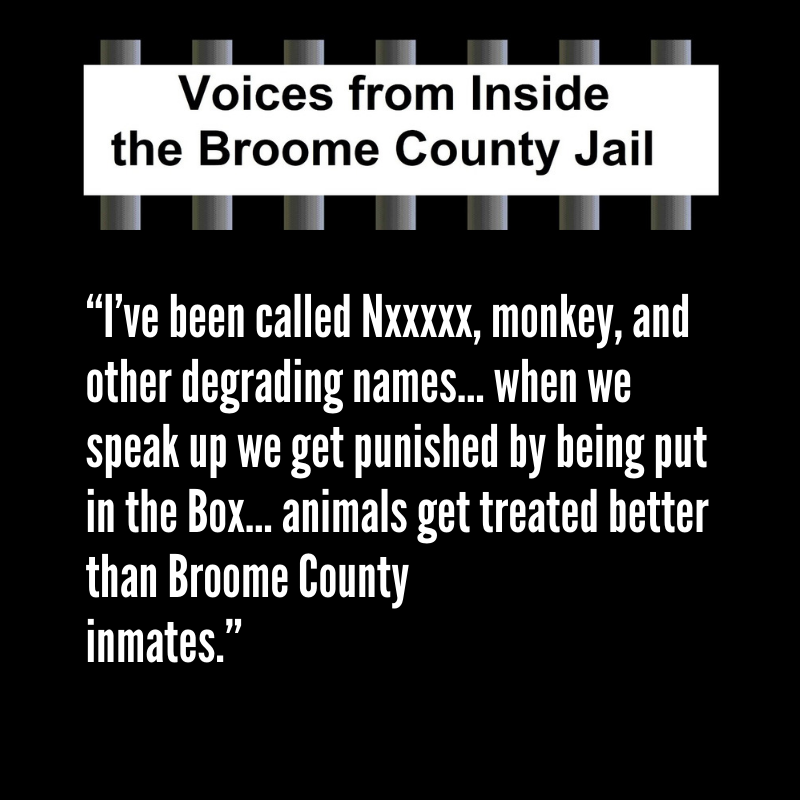
This is not an isolated case. Persons incarcerated in the jail have, in the past, openly commented on the institutionalized racism there, reporting to local organizers that officers refer to their batons as “n-word sticks,” and that they have “been called N-word, monkey, and other degrading names… when we speak up we get punished by being put in the box [solitary]”.

In 2018 the County and the Sheriff lost a major lawsuit over abuse of youth in the jail. As one expert witness testified, confirming what local youth advocates have long known,

“All the juveniles spoke of the harsh and abusive practices [of] the Correctional Officers (COs) with many identifying in exquisite detail the beatings they endured at the hands of the COs’…. [a] youth spoke of an incident in which he was restrained in a restraint chair and then pepper sprayed while he was restrained. Still another youth spoke of the COs carrying batons they used to beat the kids; they reported that the COs refer to the baton as their “n-word  [sic] beaters.”

Taej’on and his mother have considerable courage, for it is well known that even attempts to file a grievance often result in retaliation by correctional officers. To pursue any public or legal case, however, one must legally have filed grievances. This Taej’on did, with retaliation that followed.  There is no expectation of grievances being heard, even at the state level: those that get filed and sent to the State Commission of Correction are so often denied in their entirely that the State Comptroller in 2018 investigated and denounced the SCOC’s almost total rejection of all grievances.

Medical Maltreatment and Death

JUST May 23, 2019 protest outside UHS Jail Doctor’s Office

The lack of medical treatment is equally long-term and deadly. A recent survey of jail deaths in NY State by USA today, published in the local newspaper, featured the Broome County Jail prominently for good reasons. In 2014 the NY State Attorney general investigated, reprimanded, and fined the County jail’s private medical provider—yet that contract was renewed repeatedly by the County.

The County and the medical provider, Correctional Medical Care, have also lost a series of wrongful death suits, brought in the rare instances when families can mount a long and expensive legal case.  These include the 2011 death of Alvin Rios who was left “in an emergent, life-threatening status without appropriate medical attention” before dying in his cell on July 20, 2011. Questioned about multiple deaths and the lawsuit, County Sheriff David Harder blew it off, telling the media that deaths “will happen.”  In 2015, Salladin Barton, developmentally disabled and well known and liked on the streets of Binghamton, pleaded with his family: “The guards are going to kill me. You gotta get me outta here.”  He died shortly thereafter. The Sheriff’s response to Barton’s family lawsuit was equally cold and blunt:   “It’s a bunch of crap.”

A Federal Court judge had the last word however, issuing a blistering judgement in favor of Salladin’s Barton’s mother, Rose Carter, declaring

As a result of the ongoing failure by CMC to provision appropriate medical care to inmates at the County Jail, and the failure by these policymaking defendants to intervene to correct it, Barton died while in the County’s custody.”

The Judge went much further, declaring

“Sheriff Harder and/or Administrator Smolinsky, in their roles as policymakers for the Jail, possessed abundant knowledge about CMC’s egregious misconduct, knew that CMC was actively engaged in this misconduct at the County Jail, and yet failed to take any corrective action to prevent the substantial risk of harm those policies and practices posed to the inmates in their custody.

Another case, by the parents of Thomas Husar, is underway, seeking $5 million in damages for the death of their seriously ill son. His cries for help were ignored for at least 12 hours by correctional officers on November 2019—pleas echoed by other inmates. Lawsuits, like those on behalf of Thomas Husar and Taej’on Vega, remain the lonely possibility for unearthing brutality and corruption:  there is not even the most minimal county or state oversight of jail operations.  A recent state law requires police departments and county sheriffs to release disciplinary records, as might be filed for officers investigated and discharged for sexual abuse, regular drinking on the job, or bringing methamphetamines into the jail in exchange for thousands of dollars—all allegations reported to those with family members in the Broome County jail. Sheriff Harder refuses however to release any records, declaring in defiance of state law that he possesses no disciplinary records at all—as seen in multiple, denied replies to freedom-of-information requests.

And Now? Fire Harder, Terminate CMC, Investigate

The formerly incarcerated, the families of the incarcerated and the dead, and local community organizers have now collected and reported a long list of abuses and deaths to state authorities, including to the NY State Attorney General. They have testified before the state legislature.  Letters have been written to legislative leaders in Albany again regarding the brutalities meted out to Taej’on Vega. This June local community organizations called upon the Governor to remove the Sheriff from office and terminate the county’s contract with the private medical company.  Independent, open, and community-based investigation and oversight is dramatically needed. It is far past time for our elected officials to act.  How many more beatings, how many more deaths, must pass before they take action?

Bill Martin is a founding member of Justice and Unity for the Southern Tier and Bartle Professor in the Sociology Department of the State University of New York at Binghamton.

An earlier, shorter version of this report was distributed by Justice and Unity for the Southern Tier.

NY legislation proposes parole reforms, justice

Binghamton Press and Sun-Bulletin, March 21, 2021, p. A12

Bill Martin
Guest Columnist

The teenager who got hit by a bus and missed a meeting with his probation officer? Sent back to the county jail and then the state prison.

The youth who wants to live with his family rather than his assigned adult shelter? He dare not, for that will violate his probation and send him to the Broome County jail.

The local SUNY student who relapsed in his recovery from alcohol, or the women who went back to using drugs? Both are now parole violators, so back to the county jail and then a stint in a state prison.

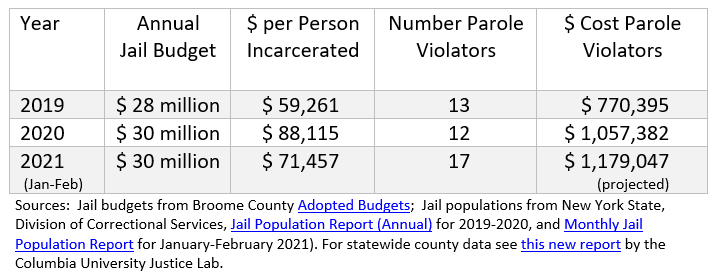
It’s a common story: A person is incarcerated not for committing a new felony, but for violating technical rules imposed by the courts and parole or probation officers. It’s a plague across the state that cost $683 million last year alone.

It’s also very costly here. Broome County is spending over $1 million a year on jailing technical parole violators. Even prior to COVID conditions and the trimming back of bail reform, the annual costs were running at $770,000 per year.

In a period when the county cuts public health nurses and mental health funding year after year, our elected officials, judges and parole officers continue to spend millions to incarcerate local residents who break technical rules and most often need treatment, not further incarceration.

Judges and parole officers often claim they have no alternative, leading them to administratively decide to incarcerate multitudes — without considering the $70,000 to $80,000 cost of doing so. Is it any wonder that Broome County regularly has the highest incarceration rate in the state? The Less is More bill before the Senate (S1144) and Assembly (A5576) offers an alternative. It proposes moderate reforms that would cut back incarcerating people for technical parole violations. It would reward persons who comply with parole requirements. It would still allow incarceration for serious violations, but would end automatic incarceration based on mere accusations of a violation. Parole officers would follow new rules and no longer fear retribution for not automatically imposing incarceration, ending an easy administrative decision that ends up costing the county $70,000 or more.

In the coming months, local faith and community organizations will be working to urge adoption of the Less is More bill. Assembly Member Donna Lupardo is a cosponsor, while Sen. Fred Akshar’s position is not known, as yet.

It’s time to vote for justice and sensible fiscal reform.

Bill Martin is a Bartle Professor at Binghamton University and founding member of Justice and Unity for the Southern Tier.

[Note: table costs added here]

Broome County Jail: COVID Leader

Why does the Broome County jail, which incarcerates 4% of the statewide county jail population, have almost 4 times that number of the reported positive COVID cases?  We were told in May there were no more cases in the jail, and yet now we learn from a freedom of information law request that positive tests keep occurring.  Why don’t we have more information on this admitted “hotspot”?

Here are the figures:

In July there were 7,248 persons incarcerated in county jails outside New York City.  After much pressure, the State Commission on Correction has at last reported a slim set of statistics on COVID cases in county jails: they report 291 positive cases to date among incarcerated persons. 

Broome County, which has 4% of the persons incarcerated in county jails using the July 2020 data, has 15% of reported cases—a figure available only after a persistent FOIL request finally got a response.

On April 20th it was declared a “hotspot” for Broome County along with local nursing homes. By early May the public was told told that all cases there were resolved, and no public comments or the data have been released since then. 

We now know that positive test result cases continue in the jail, with over dozen positive cases in quarantine/isolation among both staff and the incarcerated since late April. New cases keep cropping up right until the present.

And this is only a partial count:  we don’t know how many tests have been conducted, and how many persons have been put in solitary due to possible contact with others in the jail who have COVID. Many,  many persons report being put in lockdown, from all new arrivals to persons who live in pods with one infected individual.  As for contact tracing of staff and persons they come into contact with, there has been no information at all.

Go Figure: Broome County Covid Infection Rates

Sheriff Harder: “they’re safer inside the jail”

County Executive Garnar: “He has done a really good job in preventing the spread of the virus”

There are at least 22 positive COVID-19 tested persons in the jail with a population of approximately 450 persons (COs and incarcerated), and 290 positive cases in the county with a population of 190,000.

Newer posts »

© 2026 JUST Talk

Theme by Anders Noren — Up ↑